Sub-seasonal Antarctic Sea Ice Phase Variability and Atmospheric Drivers
Conference: Climate and Cryosphere Open Science, 2026
Author: Frida A. Perez
Background
Antarctic sea ice exhibits substantial variability on daily timescales, driven by short-lived atmospheric forcing¹˒² superimposed on a strong seasonal cycle.
Here, daily variability is defined as departures from an evolving seasonal reference frame, rather than from a fixed climatology (traditional annual cycle, TAC). This framework allows day-to-day fluctuations to be distinguished from smooth seasonal modulation.
To account for interannual differences in seasonal timing and amplitude, we apply an amplitude–phase adjusted annual cycle³ (APAC). This approach isolates daily departures relative to each year’s evolving seasonal background, rather than conflating subseasonal variability with changes in the seasonal mean.
This work investigates whether persistent daily sea ice variability provides a pathway through which short-timescale atmospheric forcing accumulates to influence seasonal advance, retreat, and the phase of the Antarctic sea ice cycle.
Extended Figures
Extended Fig. 1 — Seasonal reference frames (TAC vs IAC vs APAC)

Daily pan-Antarctic sea ice extent (SIE) departures relative to a traditional annual cycle (TAC), an invariant annual cycle (IAC), and an amplitude–phase adjusted annual cycle (APAC) illustrate how interannual shifts in the timing of advance and retreat project onto apparent daily anomalies, with APAC explicitly adjusting both the phase and amplitude of the seasonal cycle to reduce phase-aliasing during periods of rapid seasonal change.
Extended Fig. 2 — Persistence of APAC residual variability
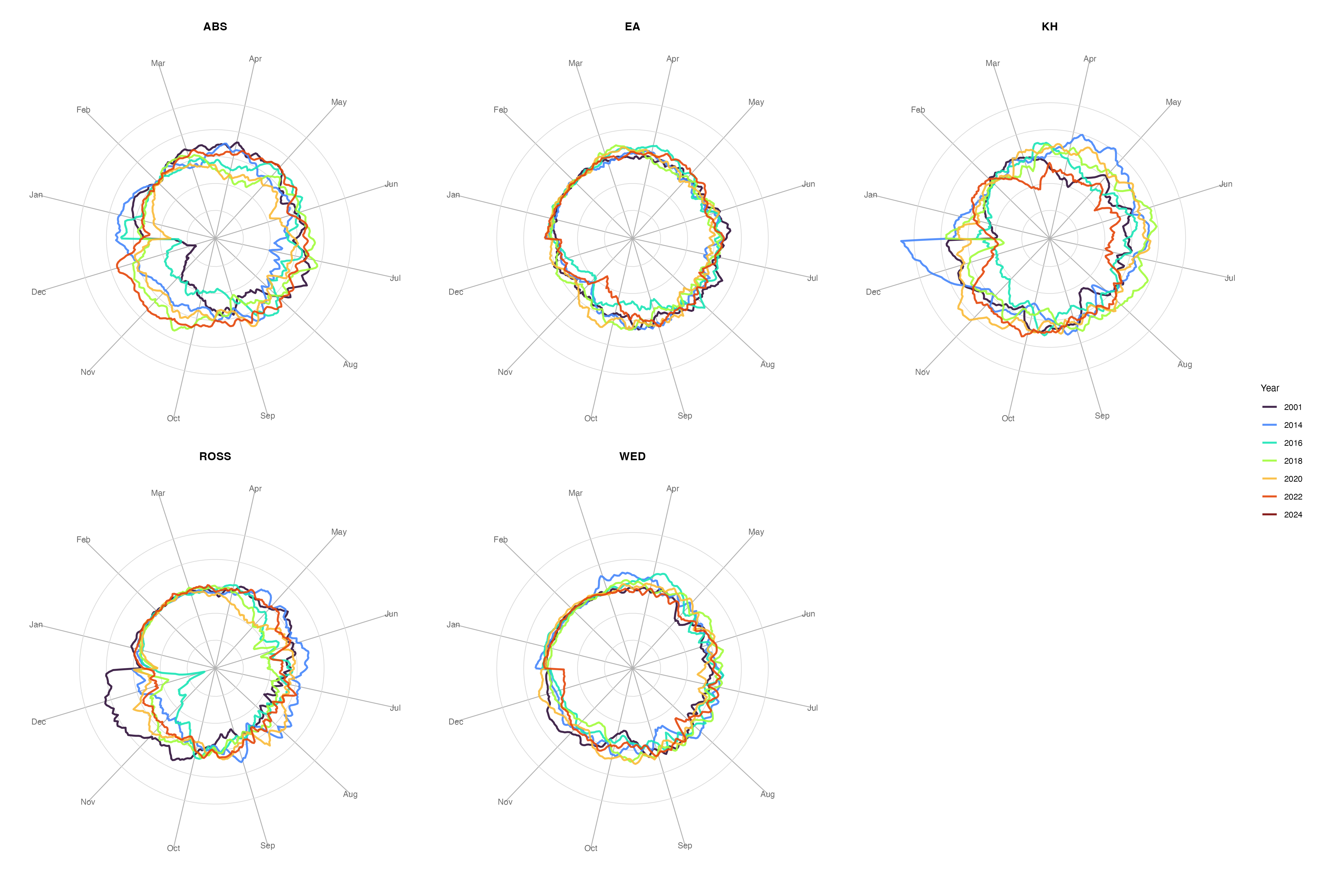
Polar plots show the seasonal evolution of APAC residual persistence by sector, where the angular coordinate represents time of year and radial distance denotes the characteristic duration of consecutive daily anomalies, revealing strong seasonal and regional contrasts in the persistence of subseasonal sea ice variability.
Extended Fig. 3 — Winter (JJA) sea ice concentration variability

The standard deviation of daily sea ice concentration during austral winter (JJA) shows enhanced variability along the marginal ice zone, indicating strong short-timescale fluctuations during the period of maximum ice extent.
Extended Fig. 4 — Spring (SON) sea ice concentration variability

Spring (SON) sea ice concentration variability increases along the retreating ice edge, reflecting heightened sensitivity during the transition from winter growth to seasonal retreat.
Extended Fig. 5 — Summer (DJF) sea ice concentration variability
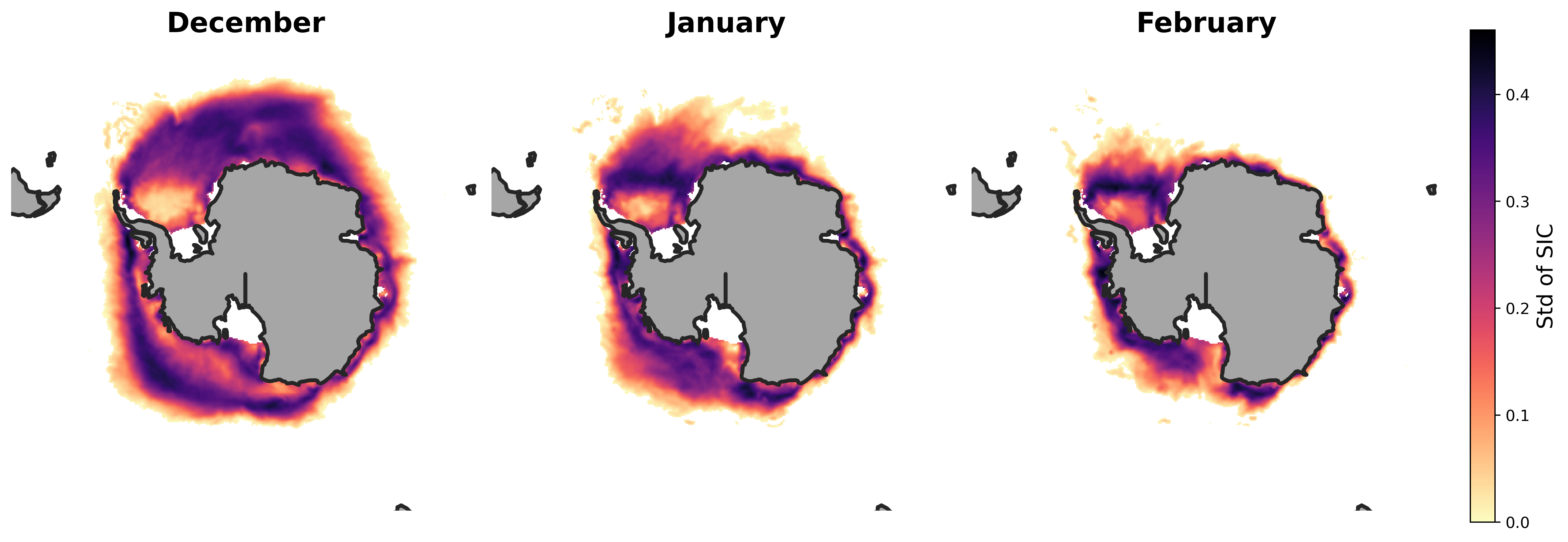
Austral summer (DJF) variability is spatially heterogeneous and concentrated near the ice margin, consistent with localized melt and retreat processes dominating short-timescale changes.
Extended Fig. 6 — Autumn (MAM) sea ice concentration variability

Autumn (MAM) variability marks the onset of seasonal advance, with increasing spatial coherence in concentration variability as the ice pack begins to expand.
Extended Fig. 7 — Seasonal reference frames in 2016


Daily sea ice departures in 2016 are shown under fixed (TAC) and evolving (IAC, APAC) seasonal reference frames, illustrating how differences in seasonal phase and amplitude affect the representation of daily anomalies across sectors.
Extended Fig. 8 — Seasonal reference frames in 2022


For 2022, evolving reference frames highlight coherent daily departures that are partially obscured under a fixed seasonal baseline during the development of anomalously low Antarctic sea ice.
Extended Fig. 9 — Seasonal reference frames in 2023


n 2023, departures relative to APAC show patterns similar to 2022 but with greater magnitude and spatial coherence across multiple sectors.
Code & Data
GitHub repository:
https://github.com/falejandraperez/Data sources:
Bootstrap SMMR/SSMI, AMSR-E, ERA5
Citations
Stammerjohn, S. E., Martinson, D. G., Smith, R. C., Yuan, X., & Rind, D. (2008). Trends in Antarctic annual sea ice retreat and advance and their relation to El Niño–Southern Oscillation and Southern Annular Mode variability. Journal of Geophysical Research: Oceans, 113, C03S90. https://doi.org/10.1029/2007JC004269
Schlosser, E., Haumann, F. A., & Raphael, M. N. (2018). Atmospheric influences on the anomalous 2016 Antarctic sea ice decay. The Cryosphere, 12(3), 1103–1119. https://doi.org/10.5194/tc-12-1103-2018
Handcock, M. S., & Raphael, M. N. (2020). Modeling the annual cycle of daily Antarctic sea ice extent. The Cryosphere, 14(7), 2159–2172. https://doi.org/10.5194/tc-14-2159-2020
Himmich, K., Vancoppenolle, M., Madec, G., et al. (2023). Drivers of Antarctic sea ice advance. Nature Communications, 14, 6219. https://doi.org/10.1038/s41467-023-41962-8
Marshall, G. J. (2003). Trends in the Southern Annular Mode from observations and reanalyses. Journal of Climate, 16(24), 4134–4143. https://doi.org/10.1175/1520-0442(2003)016<4134:TITSAM>2.0.CO;2
Contact
Email: falejandraperez@ucla.edu